
Back to your course / CR2-S02
Computing and Robotics · 2.º ESO · Learn
Autonomous robot
A robot can make sensor-based decisions within a prepared environment. You will understand how perception, priorities and movement connect, and why one lucky journey does not demonstrate reliability.
Your mission
Build an autonomous delivery robot using Maqueen Plus and micro:bit that follows a guided route and stops or diverts around obstacles according to the chosen challenge. Keep a dossier of components, priorities, calibration and three reproducible trials, including analysis of a service robot. The basic version studied stops for obstacles and lost lines.
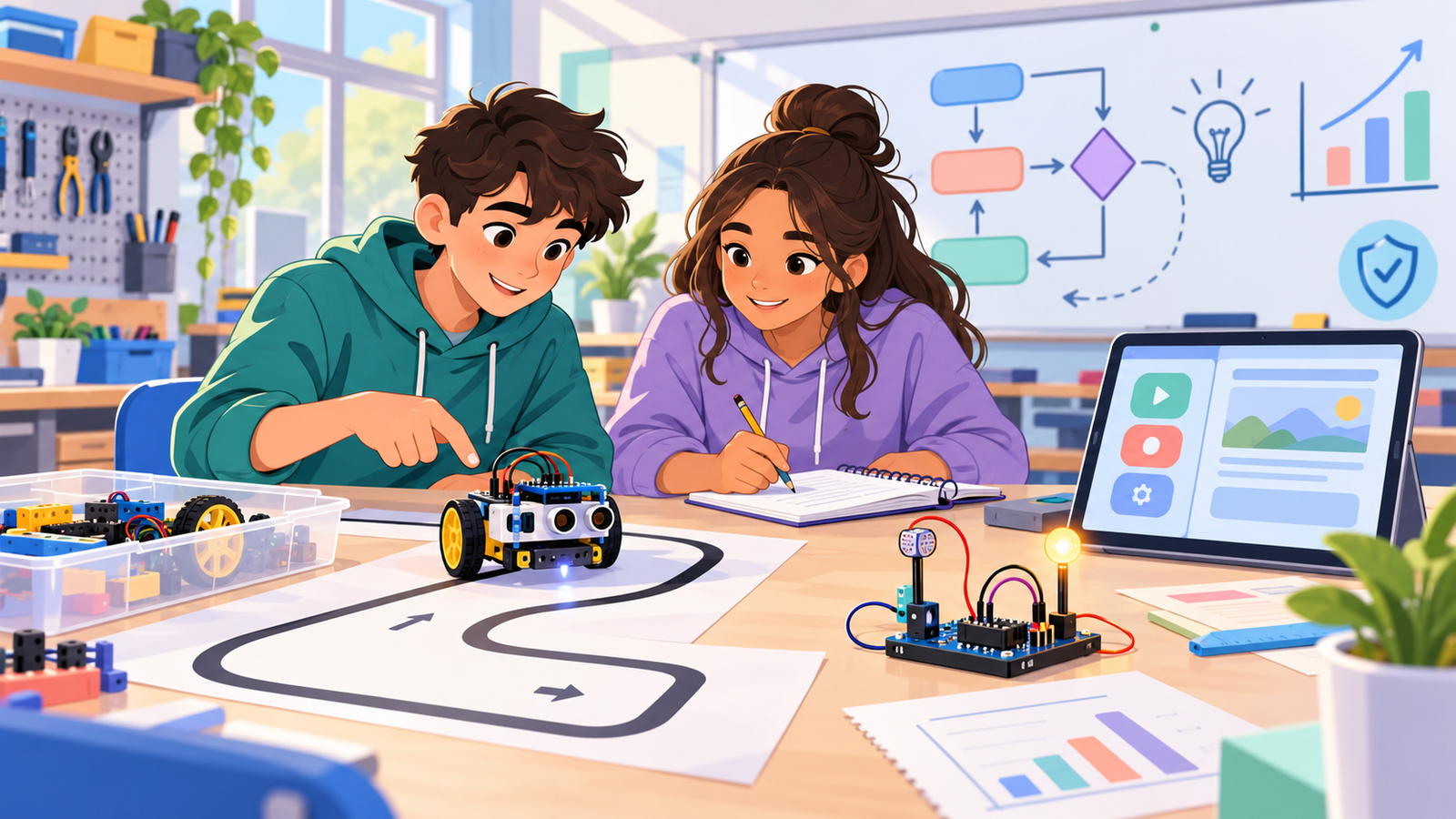
Read the explanation, study the diagram and try the activity in each section. You can choose another version at any time.
Your tools
Use Google Docs for written explanations and diagrams.net for diagrams. Save the editable file as well as the evidence requested in each task.
2.1. Autonomy within a defined environment
Learn · theory and practice
An autonomous robot uses sensor information and a program to decide some actions. Autonomy has a scope: it depends on perception, mechanisms and anticipated situations. Our mission takes place on a bounded track with a load and model obstacles. Describing starting position, route, destination and stopping conditions makes the result testable. Reaching the end is insufficient if the robot touches an obstacle or continues when it should stop.
A mobile base moves its whole body; an arm may move tools within a workspace. Useful classification connects function, environment and contact with people rather than appearance alone. An industrial robot and a service robot may share components while needing different supervision. The school prototype demonstrates one part of a social application, such as moving an object along a known route. It does not demonstrate navigation everywhere or personal-care capabilities. Define an out-of-scope condition too, so you can recognise when to interrupt a trial and review the mission.
- Delivery need
- Bounded environment
- Available capabilities
- Testable mission
A library robot carries a card between two marked areas. The team defines success as arriving, retaining the card and stopping without touching the test barrier. A dropped card is a failure even if the robot finishes quickly. If someone changes the track during travel, the case lies outside the planned environment and requires stopping before claiming a new capability.
TUTORIAL EXTENSIÓN MAQUEEN
Watch in short sections. Connect one explanation with the diagram and try the example in this section. The written theory lets you complete the activity without playing the video.
The video keeps its original spoken language. Use the captions available in the player if they help.
- In Google Docs, define mission, success, failure and an out-of-scope condition.
- In diagrams.net, draw the track, starting position, destination and stopping zones.
- In Google Docs, compare your mobile base’s function with an industrial arm and a service robot.
Why does finishing the route alone not demonstrate mission success?
2.2. Line sensors and calibration
Learn · theory and practice
Line sensors provide information about the surface underneath the robot. Their response to reflected light depends on material, gloss, height and lighting. Depending on the equipment, this information appears as a number or an already processed state. Neither means ‘robot centred’ by itself: that interpretation comes from relating readings to known positions. A pattern combines information from several sensors and describes what the assembly observes in a particular situation.
Characterisation relates these patterns to the robot being centred, offset to either side and off the line, before movement decisions are made. This explains why some readings can guide a correction while others cannot distinguish position sufficiently. If two situations requiring different actions produce the same pattern, the program lacks the information needed to tell them apart. Reviewing track width, placement or selected sensors may provide an observable difference; adding code conditions does not create that physical distinction.
Checking the track in this way is different from recalibrating the sensor internally. Maqueen Plus V2 comes factory-calibrated, and incorrect recalibration can impair detection. That adjustment is reserved for the exact version’s procedure, when appropriate and reviewed by the teacher. Another model’s meanings for black and white cannot be transferred automatically either. The readings table documents what our robot recognises and supports the actions that must subsequently be checked in motion.
- Known position
- Sensor readings
- Recorded pattern
- Testable interpretation
A wide track covers both selected sensors when the robot is centred and when it shifts slightly. The table shows the same pattern for two positions. The program cannot choose different corrections from those data. The team tries another compatible width or another available sensor and records positions again. The initial problem concerned information rather than too few blocks.
- Identify the Maqueen version and extension using the manufacturer’s documentation.
- In Google Docs, record readings on background, line, edges and the four control positions.
- In diagrams.net, connect each distinguishable pattern with an action still to be checked in motion.
When should you review the track before modifying the algorithm?
2.3. Control through priorities
Learn · theory and practice
Priorities determine which decision takes precedence when several conditions occur together. A robot can recognise a usable line and detect an obstacle at the same time; both readings can be correct. Basic control addresses manual stop or invalid data first, then obstacles, then line loss, and finally forward movement or correction. A chain of mutually exclusive cases lets the priority decision prevent a later movement branch from running.
Exclusion matters because independent commands can contradict one another within the same cycle. Calculating a single motor decision and applying it at the end makes the intended action clear. The screen message communicates that decision, while movement shows whether it was applied. Distance-based decisions also require the unit and the meanings of special values in the extension being used. An absent echo does not automatically mean a clear route. The workshop proposes stopping at 15 cm or less as a reference to be checked on the track.
The response does not necessarily occur at the instant of the reading. Instructions run between measurement and action, and the robot may keep moving during that interval. Higher speed or a longer wait can increase the distance travelled before responding; the distance reference is therefore not a universal guarantee. Cycles without long pauses allow new conditions to be checked more continuously. Besides deciding when to stop, the design states how the mission is left and what allows it to restart.
- Stop or invalid data
- Obstacle
- Usable line
- One motor command
A cart detects a barrier while its sensors still recognise a centred line. Both pieces of information are true. If one block stops and an independent later block advances, the last command may win. A table showing the final decision per cycle helps locate the conflict. Changing the line reading would not be the first correction: first review which branch is allowed to move.
Robótica microbit Maqueen 04 Sensor de obstáculos Proyecto STEAM: Robótica Aplicada al Aula
Watch in short sections. Connect one explanation with the diagram and try the example in this section. The written theory lets you complete the activity without playing the video.
The video keeps its original spoken language. Use the captions available in the player if they help.
- In diagrams.net, draw a mutually exclusive priority chain and its restart.
- In MakeCode, program one final motor decision using the validated extension.
- On the bounded track, test an obstacle with a recognised line and record command and movement in Google Docs.
Why does seeing STOP not prove that a later command has not moved the motors?
2.4. Correct the trajectory
Learn · theory and practice
A base with two driven wheels changes direction by changing the relative movement of its sides. A block’s speed command is usually a control value, not a measured physical speed. Results also depend on load, battery, friction and robot version. Identify front, left wheel and right wheel from the robot’s own perspective. This reference prevents reversed corrections when viewing the track from another side or changing your working position.
Connect each recorded pattern with advance or gentle correction and test its effect before integration. A reading does not impose a universal turn: sensor position and line width matter. Excessive correction can cross to the other edge and create zigzagging. Begin with moderate settings, check direction and change one parameter at a time. When the line is lost, the basic design stops and waits for the planned repositioning or restart. Automatic searching would be another strategy requiring its own limits and tests, and must not appear undocumented.
- Deviation pattern
- Relative wheel command
- Direction change
- New reading
A correction increases the distance from the line. The team labelled left while facing the robot and then coded as if viewing it from behind. Drawing the front reveals the reference change. They repeat a short, slow correction test with other settings unchanged. Raising power would have amplified the deviation instead of addressing its cause.
- In diagrams.net, label front, sensors and wheels from the robot’s perspective.
- In MakeCode, test each correction separately using the teacher-prepared stable support, then on the track.
- In Google Docs, record a pattern, predicted correction, its effect and the response to losing the line.
Why can a stronger correction make tracking worse?
2.5. Comparable trials and sources of variation
Learn · theory and practice
A reproducible trial describes how it was performed so another pair can repeat it. Record track, starting position, load, settings, battery and relevant surface and lighting conditions. Run at least three journeys with each compared configuration. Results include mission success, contact, line loss, failure location and, if relevant to the question, time. Fast arrival with a collision still fails the requirement even if it improves a secondary number in the record.
Comparison aims to understand a cause rather than present the best attempt alone. Change one parameter, keep others fixed and repeat the same series. If a condition could not be maintained, declare it as a limitation. Three trials show repetition on that track but do not guarantee operation everywhere or universal reliability. Define an acceptable improvement beforehand: fewer line losses without worsening stopping, for example. Keep failures and observations to explain why an option deserves another test rather than attributing every difference to the last edited block.
- Recorded conditions
- Three trials
- One adjustment
- Equivalent series
- Limited comparison
One configuration is quicker in its best attempt but fails two bends on the other journeys. Another completes all three routes with correct stopping and takes slightly longer. Choice depends on the agreed requirement rather than the most impressive time. The record identifies the troublesome bend and supports a later comparison without claiming the second configuration will work on every track.
- In Google Docs, prepare a three-trial table and define an acceptable improvement beforehand.
- Run the three journeys with MakeCode and the robot on the bounded track.
- Change one parameter in MakeCode, repeat three comparable trials and explain limitations in Google Docs.
Why is knowing only the fastest attempt insufficient to conclude a setting is better?
2.6. Analyse service robots
Learn · theory and practice
A service robot performs useful tasks within a context of use. Its value depends on audience, function, interaction and limitations rather than human appearance. Big Hero 6 invites questions about how an assistance system perceives, decides and acts. A scene provides observations from fiction; it does not demonstrate technical capability or emotional understanding. Separate what the story shows, your interpretation and a claim requiring a source before it can be considered verified.
AV01 is integrated into the twelve sessions: 0.25 for preparation, 2.25 for authorised viewing or a coherent selection, and 1 for comparison and transfer. You may use description and guided reading of the same problem without viewing outside class. Record three observations without transcribing dialogue and check one claim against technical documentation. Turn a useful function into a small Maqueen requirement, such as communicating a stop and enabling supervision. Include the conclusion in A01 and its application in A02; this creates neither a third assignment nor a medical device.
- Fictional observation
- Technical question
- Checking source
- Prototype requirement
A scene depicts an assistant approaching someone. The team observes the approach, interprets an intention to help and asks how movement would be limited. For Maqueen they propose studying a status signal when stopping. They can test that signal and a trial distance but cannot claim the robot understands human needs. Fiction has generated a question rather than a technical specification.
- In Google Docs, record an initial question and three observations from authorised viewing or its written alternative.
- Consult a technical source from the unit and identify the claim it supports and one still unverified.
- In Google Docs, formulate a transferable requirement and its test for inclusion in A01 and A02.
How does observing a capability in a film differ from demonstrating it with the robot?
2.7. Laboratory, project and two assignments
Learn · theory and practice
The laboratory connects perception, control, mechanism and power. A sensor supplies distance or a pattern; micro:bit decides; the motor interface applies a command; wheels and surface produce the journey. Drawing this map locates different causes of the same symptom. If the robot turns towards an obstacle, the reading, priority or motor mapping may be wrong. Observing input, final decision and movement separately supports investigation without changing every part.
A01 includes mission, justified components, states, priorities, predictions and a physical micro-execution. A02 integrates the robot, three comparable journeys, a corrected fault and individual explanation. States such as stopped, tracking or facing an obstacle need clear transitions: entering stopped does not itself explain how restarting works. A starts and B stops in the workshop, with restart behaviour declared. Evidence includes a functional mechanical diagram and material reuse. Simulation may support logical reasoning, but physical tracking and stopping results are documented using the actual robot version.
- Physical reading
- Prioritised decision
- Interface command
- Observed movement
- Diagnosis
The screen says CORRECT RIGHT, but the base turns the other way. The sensor table matches the physical position and priority is unchanged. The team tests each wheel on the teacher’s support to check command mapping. This narrows the mechanical or interface hypothesis. Changing the line table first could hide the fault and damage other situations.
- In diagrams.net, connect sensor, controller, interface, motors and supply.
- In MakeCode, integrate control in stages and check A, B and the planned restart.
- In Google Docs, record symptom, investigated cause, repair and repetition of a physical test.
Which observation would distinguish a wrong priority from a misidentified wheel?
2.8. Explore further at your own pace
Learn · theory and practice
The robot version is part of the technical explanation. Maqueen Lite, Plus V1 and Plus V2 tutorials may share ideas without guaranteeing identical extensions, sensors or connections. Manufacturer documentation identifies model, library and procedure. Before reusing a block, check its function, unit and special-result meanings. A similar photograph or abbreviated name is insufficient to decide compatibility or select internal calibration procedures.
Reasoned adaptation distinguishes structure from parameters. The chain prioritising stop may remain on another track, while line patterns, control speed and distance reference require fresh verification. A tighter bend calls for investigating whether the robot still obtains information in time and can correct without losing the track. Optional videos review movement with pauses and written support. Record their version and the question they answer. Extending obstacle diversion requires its own states, recovery and tests; it does not silently replace basic stopping or authorise testing outside the bounded space.
- Identified version
- Documented block
- Adapted pattern
- New-track trial
Another pair shares a program for a different Maqueen. Its priority map seems useful, but the sensor block differs from our extension. The team keeps the map as a reference and checks its model’s block before interpreting results. They then repeat known positions. Reusing the idea does not mean declaring files compatible or copying another model’s hardware calibration.
- Consult manufacturer references and record model, extension and a reading unit in Google Docs.
- In diagrams.net, mark which control parts you would keep on a different track.
- In Google Docs, design a new check for a different bend or pattern without adding an assignment.
Which test is missing before claiming the same program works on another track?
Your project and submissions
A01 · Design the solution
- Create CR2-S02_robot_A01_Apellidos in Google Docs with mission, audience, success and limits.
- Justify components and robot type; draw track, mechanism and state map in diagrams.net.
- Define stop, obstacle and line priorities; predict three cases and prepare three comparable trials.
- Run a physical sensor-and-motor micro-test using MakeCode and the version-specific extension; record readings and result.
- Include the Big Hero 6 or written-alternative conclusion, reusable materials, sources and individual contributions.
What to submit
- Dossier with social mission, components, states and priorities.
- Actual-version readings table and documented physical micro-test.
- Three predictions and trial plan; requirement transferred from film or written analysis and individual explanation.
A02 · Autonomous delivery robot
- Integrate the robot using MakeCode, the validated extension and revised design.
- Check background, line and edges; test obstacle during tracking, lost track and B stop during movement.
- Run three comparable journeys and record every result, including failures and investigated causes.
- Change one parameter, repeat an equivalent series and justify the improvement and its limits.
- Submit CR2-S02_robot with editable code, mechanical diagram, calibration, start-and-stop instructions, records, sources and individual explanation of decisions and social usefulness.
What to submit
- Integrated robot demonstrating tracking and stopping on the prepared track.
- Editable code, physical patterns and commands consistent with states.
- Three trials and improvement comparison; individual contribution and connection to the social requirement and materials used.
Before you submit
- I define what my robot can do on this track.
- I connect real readings with patterns without copying another version.
- I demonstrate stop priority when a line is also present.
- I explain how a wheel difference changes the route.
- I compare three trials and an improvement without hiding failures.
- I distinguish fiction, verified claims and demonstrated capability.
Templates and files
Open the blank A01 or A02 template and make your own copy in Google Docs. Keep the editable file from your project platform as well.
These reusable templates help you organise your work. Follow the specific instructions and evidence list for this unit; remove fields that do not apply. The blank master is read-only. Keep your answers private and share them only as your teacher instructs.
A01 · Design the solution
Make your own copy in Google Docs · View the blank template
- Dossier with social mission, components, states and priorities.
- Actual-version readings table and documented physical micro-test.
- Three predictions and trial plan; requirement transferred from film or written analysis and individual explanation.
A02 · Autonomous delivery robot
Make your own copy in Google Docs · View the blank template
- Integrated robot demonstrating tracking and stopping on the prepared track.
- Editable code, physical patterns and commands consistent with states.
- Three trials and improvement comparison; individual contribution and connection to the social requirement and materials used.
Classroom rubrics
The classroom assessment reference is preserved below in its original Spanish. Use the checklist above to prepare your work and ask your teacher about any descriptor you need to clarify.
Consultar la rúbrica de A01
Diseño y microprueba
CYR.2.1.2 Aplicaciones sociales del robot autónomo
Reconocer el papel de la robótica en nuestra sociedad, conociendo las aplicaciones más comunes.
Evidencia. Misión, destinatario y comparación con un uso social documentado.
| Banda | Desempeño observable |
|---|---|
| 1–2,9 | Atribuye autonomía ilimitada al robot y no reconoce una tarea social concreta. |
| 3–4,9 | Nombra reparto, pero no relaciona percepción y actuación con condiciones del destinatario. |
| 5–6,9 | Relaciona la misión con una aplicación social y explica utilidad y límites del robot y de la representación audiovisual. |
| 7–8,9 | Compara dos usos y argumenta una condición social, ambiental o de supervisión que afecta al diseño. |
| 9–10,0 | Justifica cuándo conviene automatizar la misión con evidencia y cuándo la intervención humana sigue siendo necesaria. |
CYR.2.1.4 Calibración y principios del movimiento
Comprender los principios de ingeniería en los que se basan los robots, su funcionamiento, componentes y características.
Evidencia. Lecturas del modelo real, esquema y microprueba de sensor y motores.
| Banda | Desempeño observable |
|---|---|
| 1–2,9 | Interpreta los valores del sensor sin calibración o confunde orden y movimiento. |
| 3–4,9 | Identifica sensores y motores, pero copia patrones de otro modelo o no relaciona giro y velocidades. |
| 5–6,9 | Registra lecturas del modelo preparado, relaciona sensores, control y motores y ejecuta una microprueba de corrección o parada. |
| 7–8,9 | Explica cómo una corrección cambia la trayectoria y contrasta su efecto manteniendo pista y condiciones. |
| 9–10,0 | Compara dos correcciones y justifica su elección según estabilidad y detección disponible. |
CYR.2.2.1 Prioridades y generalización de la misión
Conocer y resolver la variedad de problemas posibles, desarrollando un programa informático y generalizando las soluciones, tanto de forma individual como trabajando en equipo, colaborando y comunicándose de forma adecuada.
Evidencia. Pseudocódigo, estados, tres predicciones y microejecución colaborativa.
| Banda | Desempeño observable |
|---|---|
| 1–2,9 | El algoritmo ordena avanzar después de parar y no reconoce la contradicción. |
| 3–4,9 | Define seguimiento, pero no incluye pérdida de línea u obstáculo ni explica aportación individual. |
| 5–6,9 | Ordena prioridades de parada, obstáculo y línea, ejecuta una parte y anticipa tres casos. Comunica su aportación y revisa otra propuesta. |
| 7–8,9 | Prueba entradas simultáneas y justifica el orden de prioridades con la misión. |
| 9–10,0 | Adapta la misma estructura a otra ruta y acuerda una solución que conserva parada y final. |
CYR.2.3.1 Integración física y aceptación de la misión
Ser capaz de construir un sistema de computación o robótico, promoviendo la interacción con el mundo físico en el contexto de un problema del mundo real, de forma sostenible.
Evidencia. Microensayo físico y requisitos de reparto parada materiales y reutilización.
| Banda | Desempeño observable |
|---|---|
| 1–2,9 | No comprueba movimiento físico ni vincula el montaje con una necesidad de reparto. |
| 3–4,9 | Hay movimiento, pero el diseño omite aceptación o atribuye al simulador validación de toda la misión. |
| 5–6,9 | Integra una primera interacción real, define misión y tres pruebas y justifica materiales y reutilización. |
| 7–8,9 | Revisa un requisito al detectar una limitación de pista, carga o alcance del sensor. |
| 9–10,0 | Compara una alternativa física y argumenta su utilidad con una prueba y sus recursos. |
Consultar la rúbrica de A02
Producto pruebas y mejora
CYR.2.1.2 Aplicaciones sociales del robot autónomo
Reconocer el papel de la robótica en nuestra sociedad, conociendo las aplicaciones más comunes.
Evidencia. Demostración de reparto y explicación de utilidad contexto y límites.
| Banda | Desempeño observable |
|---|---|
| 1–2,9 | La utilidad expuesta depende de capacidades no implementadas ni contrastadas. |
| 3–4,9 | La misión funciona parcialmente, pero la explicación social es un listado sin relación con los resultados. |
| 5–6,9 | Explica aplicación, destinatario y contexto, usando pruebas para delimitar lo que el robot autónomo puede hacer. |
| 7–8,9 | Contrasta un beneficio y una limitación con otra aplicación y revisa una condición de uso. |
| 9–10,0 | Evalúa una alternativa al reparto robótico con argumentos de accesibilidad, supervisión o recursos y pruebas pertinentes. |
CYR.2.1.4 Calibración y principios del movimiento
Comprender los principios de ingeniería en los que se basan los robots, su funcionamiento, componentes y características.
Evidencia. Esquema mecánico funcional, calibración, giros y prueba de parada.
| Banda | Desempeño observable |
|---|---|
| 1–2,9 | La explicación de componentes no corresponde al robot o no puede detenerlo según el montaje previsto. |
| 3–4,9 | Sigue parte de la línea, pero no explica patrones de lectura o corrige movimientos al azar. |
| 5–6,9 | Demuestra seguimiento y parada, explica componentes y movimiento y usa calibración y esquema coherentes con el robot real. |
| 7–8,9 | Diagnostica oscilación o desviación diferenciando lectura, regla y actuación y comprueba la reparación. |
| 9–10,0 | Recalibra en otra pista preparada y justifica qué cambia por superficie o velocidad y qué principio permanece. |
CYR.2.2.1 Prioridades y generalización de la misión
Conocer y resolver la variedad de problemas posibles, desarrollando un programa informático y generalizando las soluciones, tanto de forma individual como trabajando en equipo, colaborando y comunicándose de forma adecuada.
Evidencia. Código, recorridos, fallo corregido y explicación o cambio individual.
| Banda | Desempeño observable |
|---|---|
| 1–2,9 | No resuelve la misión ni puede explicar una prioridad del programa. |
| 3–4,9 | Resuelve un recorrido, pero un caso combinado produce órdenes contradictorias y no localiza su causa. |
| 5–6,9 | Programa prioridades y misión, registra ensayos y corrige un fallo con aportaciones individuales y colaboración documentadas. |
| 7–8,9 | Reutiliza el algoritmo en otra ruta, modifica parámetros justificados y comprueba entradas simultáneas. |
| 9–10,0 | Resuelve una variante nueva y compara dos estrategias manteniendo requisitos y comunicación razonada del equipo. |
CYR.2.3.1 Integración física y aceptación de la misión
Ser capaz de construir un sistema de computación o robótico, promoviendo la interacción con el mundo físico en el contexto de un problema del mundo real, de forma sostenible.
Evidencia. Robot integrado, tres recorridos comparables y mejora con límites registrados.
| Banda | Desempeño observable |
|---|---|
| 1–2,9 | No aporta misión física verificable ni explica las condiciones de uso. |
| 3–4,9 | El robot avanza, pero no supera la aceptación de parada o ruta y no analiza el fallo. |
| 5–6,9 | Demuestra misión y parada en la pista preparada, registra tres recorridos y una corrección y explica límites y recursos. |
| 7–8,9 | Contrasta una mejora con las mismas condiciones y separa tiempo, pérdidas de línea y éxito. |
| 9–10,0 | Prueba otra condición preparada y justifica la decisión de diseño sin extrapolar a entornos no comprobados. |
Videos, resources and sources
RETO 6 MAQUEEN
Watch in short sections. Connect one explanation with the diagram and try the example in this section. The written theory lets you complete the activity without playing the video.
The video keeps its original spoken language. Use the captions available in the player if they help.
RETO 4 MAQUEEN
Watch in short sections. Connect one explanation with the diagram and try the example in this section. The written theory lets you complete the activity without playing the video.
The video keeps its original spoken language. Use the captions available in the player if they help.
RETO 2 MAQUEEN
Watch in short sections. Connect one explanation with the diagram and try the example in this section. The written theory lets you complete the activity without playing the video.
The video keeps its original spoken language. Use the captions available in the player if they help.
Keep learning
- DFRobot: micro:Maqueen Plus V2 Reference
- DFRobot: Getting Started with micro:Maqueen Plus V2
- DFRobot: Let’s move, Maqueen! Tutorial 02
- DFRobot: código fuente de la extensión Maqueen Plus
Editorial revision: October 2026.